Santorini in winter is quieter, less crowded, and very different from the island most visitors experience between May and September. You will not find the same beach atmosphere, nightlife or huge choice of restaurants and tours, but you will find peaceful villages, uncrowded viewpoints, hiking trails and a much slower side of Santorini.
So, is Santorini worth visiting in winter? Yes — if you are looking for sightseeing, local life, walking, food, wine and the scenery without the summer crowds. If your ideal Santorini holiday revolves around swimming, beach clubs, nightlife and a full choice of tours and restaurants, the warmer months will probably suit you better.
Winter in Santorini generally runs from November through March. The weather is mild compared with much of Europe, although you should expect cooler temperatures, wind, rain and occasional periods of unsettled weather. Many seasonal businesses close, while Fira and other year-round communities continue to operate.
The key is knowing what changes once the tourist season ends.
In this guide, we explain what Santorini is really like during winter, including the weather, what stays open, where to stay, what you can do, and how to get around the island during the quieter months.
What Is Santorini Really Like in Winter?
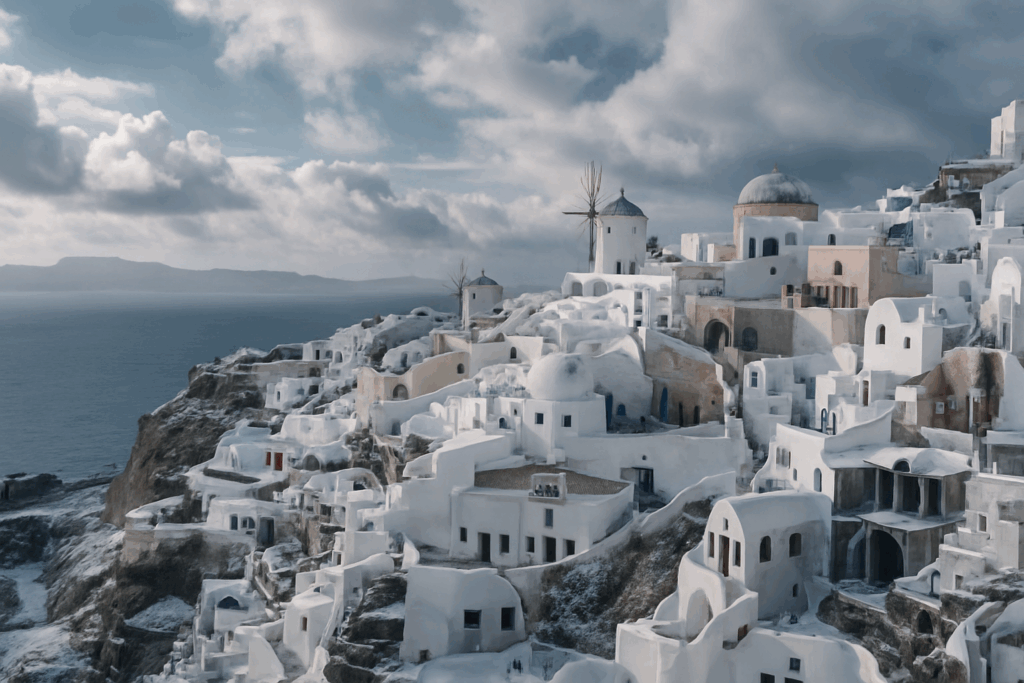
Santorini in winter feels almost like a different island. The famous caldera, whitewashed villages, and sunsets are still there, but the pace of everyday life changes considerably once the main tourist season ends.
The biggest difference is the number of visitors. Places such as Oia and Fira that can become extremely busy during summer are much quieter, particularly in December, January and February. You can walk through the narrow streets, stop at viewpoints and explore villages without planning your day around crowds.
At the same time, winter Santorini is not simply a less crowded version of summer Santorini. Many hotels, restaurants, beach businesses and tourism-focused shops close for part or all of the off-season. Excursions and organised activities are also more limited, and the island becomes much more dependent on the businesses and services used by permanent residents.
Winter Santorini Is Better for Exploring Than for a Resort Holiday
The quieter atmosphere changes what makes a winter trip worthwhile.
Instead of spending the day at the beach or moving between busy attractions, winter is particularly suited to exploring villages, visiting archaeological and cultural sites, walking when the weather allows, enjoying local food and seeing more of everyday life on the island.
It can also be an excellent time for photography. Popular viewpoints are considerably less crowded, while changing winter skies can create a very different landscape from the bright, dry conditions associated with summer.
There is a trade-off, however. Days are shorter, the weather is less predictable, and you cannot assume that every restaurant, attraction, or activity you find online will be operating when you arrive.
That is why a winter trip to Santorini benefits from a little more planning than you might expect from such a popular destination.
In simple terms: visit Santorini in winter for the scenery, villages, history, and slower pace — not for beaches, nightlife, or the full summer tourism experience.
Santorini Winter Weather: What to Expect from November to March
Santorini has a mild Mediterranean winter, but that does not mean you should expect warm, summer-like weather. From November to March, temperatures are considerably cooler, rain becomes more frequent, and strong winds can make some days feel colder than the thermometer suggests.
As a general guide, daytime temperatures range from around 14°C (57–58°F) during the coldest part of winter to around 19°C (66°F) in November. Nights are cooler, typically ranging from around 9°C to 14°C (49–57°F).
The weather can also change quickly. A sunny morning may be followed by clouds, wind, or rain, so flexibility is useful when planning outdoor activities.
Santorini in November
November is a transition month between the tourist season and winter. Average daytime highs are around 19°C (66°F), with nights averaging around 14°C (57°F).
Early November can still produce pleasantly mild and sunny days, but rainfall becomes more frequent as the month progresses. It is a good month for visitors who want a quieter Santorini without experiencing the coolest part of winter.
Santorini in December
By December, winter has clearly arrived. Average daytime highs are around 16°C (61°F), falling to approximately 11°C (52°F) at night.
December is also typically the wettest month of the year in Santorini. This does not mean that it rains continuously, but visitors should expect a mixture of sunny, cloudy, windy, and rainy days rather than guaranteed sunshine.
With shorter daylight hours, it is worth planning sightseeing and outdoor activities earlier in the day.
Santorini in January
January is one of Santorini’s coolest and wettest months. Average temperatures are around 14°C (58°F) during the day and 10°C (50°F) at night.
Wind can make exposed areas around the caldera feel noticeably colder, particularly in the evening. However, clear and sunny periods are still possible, making January suitable for sightseeing if you are prepared to adjust your plans around the weather.
This is very much the off-season, so visitors should come expecting a quiet island rather than a conventional Greek island holiday.
Santorini in February
February is statistically the coldest month of the year in Santorini, although the difference from January is small. Average daytime highs are around 14°C (58°F), with nighttime temperatures around 9–10°C (49°F).
Rain remains possible and Santorini can be windy, but February also brings gradually increasing daylight as the island moves towards spring.
For visitors primarily interested in landscapes, villages, photography and experiencing Santorini at its quietest, the weather can still be perfectly manageable with the right clothing.
Santorini in March
March begins the transition towards spring. Average daytime highs rise to around 16°C (61°F), while rainfall generally becomes less frequent than during December, January and February.
Conditions can still be unpredictable, particularly early in the month, but longer days make sightseeing and outdoor exploration easier.
Towards the end of March, the island gradually begins preparing for the main visitor season, although travellers should still expect many seasonal businesses to remain closed.
Does It Snow in Santorini?
Snow in Santorini is extremely unusual. Winter precipitation normally falls as rain, and temperatures at sea level generally remain well above freezing.
The bigger weather considerations for a winter visit are rain and wind rather than snow or extreme cold.
For most travellers, a waterproof jacket, layers, comfortable closed shoes and something wind-resistant are more useful than heavy winter clothing.
The key thing to remember is that Santorini’s winter is mild, not warm: you can have beautiful sunny days, but you should plan your trip assuming that rain, wind and cooler weather are all possible.
What Is Open in Santorini During Winter?
Santorini does not close for the winter. The island has a permanent population, so supermarkets, bakeries, pharmacies, cafés, restaurants and other everyday services continue to operate throughout the year.
What changes is the tourism infrastructure.
Many businesses created primarily for summer visitors close between late autumn and spring. This is particularly noticeable in resort areas and in parts of Oia, where hotels, restaurants, shops and tourism businesses may operate seasonally.
Fira is generally the most practical place to find year-round services in winter, while other villages have fewer options than they do during the main tourist season.
Here is what you can generally expect.
Restaurants and Cafés
You will still be able to eat out in Santorini during winter, but the choice is considerably smaller than in summer.
Fira has the largest concentration of year-round cafés, bakeries, restaurants and tavernas because it serves both visitors and residents. You can also find places operating in other permanently inhabited villages, although options become more limited away from the island’s main population centres.
Oia is much quieter. Some businesses remain open, but many of the restaurants and cafés aimed primarily at summer visitors close during the off-season.
Rather than building your plans around a particular restaurant you have found online, check its current opening hours shortly before visiting. Seasonal opening dates can change from year to year.
Hotels and Accommodation
Santorini still has accommodation available during winter, but only a portion of the island’s hotels operate year-round.
Many of the caldera hotels and seasonal resorts close during the quieter months for maintenance and preparation for the following season.
For a winter visit, Fira can be particularly practical because you are close to restaurants, shops and everyday services that operate throughout the year. Staying in a more isolated part of the island can be wonderfully peaceful, but it may also mean travelling whenever you want to eat, shop or visit another area.
Always check that the accommodation is actually operating on your travel dates rather than assuming availability from an old listing.
Archaeological Sites and Museums
Winter can actually be an excellent time to explore Santorini’s history.
Major cultural attractions continue to operate during the winter season, although opening hours are usually shorter than in summer.
The Museum of Prehistoric Thera in Fira, for example, operates on a winter timetable from November through March. Archaeological sites and museums may also have weekly closing days or changes to their schedules during public holidays.
Akrotiri, Ancient Thera and Santorini’s archaeological museums should therefore be checked individually before visiting.
The advantage is significant: when sites are open, winter visitors can often explore them without the large groups and queues associated with the busiest months.
Wineries
Wine does not disappear from Santorini when summer ends.
The island’s vineyards may look very different in winter, but several wineries continue to offer visits or tastings outside the main tourist season.
Not every winery remains open daily, however. Some operate reduced winter hours, while others accept visitors only by appointment.
If visiting Santorini’s wineries is important to your trip, contact the winery beforehand rather than relying on summer opening information found online.
Shops and Everyday Services
Supermarkets, pharmacies, bakeries, banks and businesses serving Santorini’s permanent residents continue operating during winter.
Tourist shops are different. Many souvenir shops, boutiques and businesses aimed predominantly at visitors close during the off-season, particularly in highly seasonal areas.
This distinction is useful when planning a winter trip:
Santorini still functions normally as a place where people live — it simply stops functioning at full capacity as a summer tourist destination.
Tours, Boat Trips and Organised Activities
This is where winter visitors should be most cautious.
The choice of organised tours and excursions is significantly smaller than in summer. Boat trips, sailing excursions and other weather-dependent activities may operate only on selected dates, with reduced schedules, or not at all during parts of the winter.
Private land-based tours can be easier to arrange, but availability should still be confirmed in advance.
If a particular excursion is essential to your trip, do not assume that a summer itinerary advertised online will also operate in January or February.
So, Will Santorini Feel Closed in Winter?
It depends heavily on where you stay and what you expect.
Stay in or near Fira, and you will still find everyday activity, places to eat, and essential services. Spend time in highly seasonal resort areas, and the island can feel exceptionally quiet.
For many winter visitors, that is part of the attraction.
The important thing is to arrive knowing that Santorini is open in winter, but it operates for its residents first and tourists second — almost the reverse of what you experience during the peak summer months.

Best Things to Do in Santorini in Winter
Winter changes the way you experience Santorini. Swimming, beach clubs and the full programme of sailing excursions may be largely off the agenda, but many of the island’s most memorable experiences do not depend on summer weather at all.
In fact, some places are considerably easier to enjoy without the crowds and heat of the peak season.
1. Explore Oia Without the Summer Crowds
Oia is one of the places where the difference between summer and winter is most dramatic.
During peak season, its narrow lanes and famous viewpoints can become extremely crowded, particularly around sunset. In winter, you can explore the village at a much slower pace.
Walk through the pedestrian lanes, photograph the blue-domed churches and caldera views, and visit the area around the Castle of Oia without having to navigate large groups of visitors.
Many tourism-focused businesses will be closed, so come for the village and the landscape rather than shopping or nightlife.
2. Spend Time in Fira
Fira is particularly important during a winter visit because it remains the island’s main commercial and administrative centre.
Walk along the caldera, explore the streets around the centre and combine sightseeing with the museums, cafés and restaurants that remain open during the quieter months.
Because more year-round services are concentrated here, Fira is also a useful base from which to explore the rest of Santorini.
3. Discover Santorini’s Traditional Villages
Winter is an excellent opportunity to look beyond Oia and Fira.
Villages such as Pyrgos, Megalochori and Emporio offer narrow lanes, traditional architecture, churches and a much quieter atmosphere.
Without the pressure of a packed sightseeing schedule, you can simply walk through them and experience parts of Santorini that are sometimes overlooked during shorter summer trips.
Pyrgos is particularly rewarding for its elevated position and panoramic views across the island, while Emporio’s historic centre provides a very different setting from the familiar caldera villages.
4. Visit Akrotiri and Santorini’s Museums
Santorini’s history extends far beyond its famous whitewashed villages.
The prehistoric settlement of Akrotiri is one of the island’s most important archaeological attractions. Preserved beneath volcanic material following the Bronze Age eruption of Thera, the site offers an entirely different perspective on the island.
In Fira, the Museum of Prehistoric Thera displays important finds from Akrotiri and other prehistoric sites on Santorini. [Source: Ministry of Culture]
Winter opening hours are generally shorter, so always check the official schedule before travelling to a site or museum.
5. Hike from Fira to Oia — If the Weather Is Suitable
The walking route between Fira and Oia follows the caldera and is one of Santorini’s best-known hikes.
Winter has one major advantage for walking: you avoid the intense summer heat.
However, conditions matter. Rain can make sections of the route slippery, while strong winds can make exposed stretches uncomfortable or potentially unsafe.
Choose a dry, calm day, wear appropriate footwear and allow plenty of daylight to complete the route.
If the weather is poor, save the hike for another day rather than treating it as an essential part of your itinerary.
6. Experience Santorini’s Wine Culture
Santorini’s volcanic soil and distinctive vine-growing methods have created one of Greece’s most interesting wine regions.
Winter provides an opportunity to focus on the wine itself rather than combining a winery visit with a busy summer sightseeing schedule.
Some wineries remain available for tastings during the off-season, although winter opening arrangements vary considerably. Reservations are therefore strongly recommended.
Look out particularly for wines produced from Assyrtiko, the white grape variety most closely associated with Santorini.
7. Visit the Beaches for the Landscape
Santorini’s beaches are worth seeing even when it is far too cold to swim.
Red Beach, Perissa, Perivolos and other coastal areas reveal the island’s volcanic geology particularly clearly. In winter, they can also be remarkably peaceful.
Think of them as scenic stops rather than beach-day destinations. Many seasonal businesses along the coast will be closed, and wind or rough seas can completely change the character of the shoreline.
8. Watch the Sunset Without Planning Your Day Around It
Santorini’s sunsets do not have an off-season.
What disappears in winter is much of the competition for the best viewpoint.
Oia remains the famous choice, but you do not necessarily need to travel there specifically for sunset. The caldera viewpoints around Fira, Firostefani and Imerovigli can be equally rewarding, particularly when winter clouds add colour and texture to the sky.
And unlike in summer, there is usually little reason to arrive an hour early simply to secure a place to stand.
9. Photograph a Different Side of Santorini
Winter Santorini has a different visual character.
Cloud formations, changing light, greener landscapes and quieter streets can produce photographs that look very different from the familiar summer images of the island.
The lack of crowds also makes architectural photography considerably easier in places such as Oia, Pyrgos and the smaller villages.
For photographers, the unpredictable winter weather can sometimes be an advantage rather than an inconvenience.
10. Slow Down
This may be the most underrated winter activity of all.
Santorini receives millions of visitors during the tourist season, and summer trips can easily become a checklist of viewpoints, restaurants, beaches and excursions.
Winter removes much of that pressure.
Have coffee in Fira. Walk through a village without a timetable. Stop at a viewpoint because nobody is waiting behind you for the same photograph. Change your plans because the weather changed.
Winter Santorini rewards travellers who are willing to experience the island rather than simply complete its list of attractions.
Where to Stay in Santorini in Winter
Choosing where to stay in Santorini is particularly important during winter. In summer, almost every major tourist area is surrounded by restaurants, shops and services. During the off-season, that is no longer the case.
For most winter visitors, Fira is the best and most practical place to stay in Santorini. It has the greatest concentration of year-round services, places to eat and transport connections, while still offering easy access to the caldera and the rest of the island.
That does not mean Fira is your only option. The right choice depends on whether you value convenience, solitude, or a more local experience.
Fira: Best Overall Choice for Winter
If this is your first winter trip to Santorini, Fira is the safest choice.
As the island’s main town, Fira remains active throughout the year. You have a better chance of finding restaurants, cafés, bakeries, supermarkets, and other everyday services within walking distance, and the island’s main bus station is located here.
It is also centrally positioned for exploring Santorini.
Another advantage is flexibility. If bad weather changes your plans for the day, staying somewhere with year-round activity nearby becomes much more valuable than it might seem when booking your trip.
Best for: first-time winter visitors, travellers without a car and anyone who prioritises convenience.
Firostefani: Caldera Views Close to Fira
Firostefani can offer a useful compromise between scenery and practicality.
It sits immediately north of Fira along the caldera, so you can enjoy a quieter environment while remaining within walking distance of the island’s main town.
There will generally be fewer businesses operating around you than in central Fira, but being able to walk into Fira makes this much less of a problem.
Best for: travellers who want caldera scenery and tranquillity without becoming too isolated.
Imerovigli: Beautiful but Very Quiet
Imerovigli offers some of Santorini’s most impressive caldera views, and winter makes an already peaceful village considerably quieter.
That can be exactly what you are looking for — or inconvenient.
Many tourism-oriented businesses operate seasonally, so you should check what will actually be available around your accommodation before booking. Having a car or arranging transportation makes staying here easier during winter.
Best for: couples, photographers and travellers specifically looking for peace, views and solitude.
Oia: Iconic, Peaceful and Much Quieter Than You May Expect
Staying in Oia during winter gives you an experience that would be almost impossible during peak season: waking up in one of Santorini’s most famous villages without the summer crowds.
The trade-off is convenience.
A significant part of Oia’s tourism economy is seasonal, so the choice of hotels, restaurants and shops is much smaller during winter. Transport options are also more limited than during the main season.
Oia can therefore be a wonderful winter base if you deliberately want tranquillity and are comfortable planning your meals and transportation.
If convenience is more important, visit Oia as a day trip and stay in Fira instead.
Best for: returning visitors, couples and travellers who value atmosphere and solitude over convenience.
Pyrgos, Megalochori and Other Inland Villages
Santorini’s inland villages offer another interesting possibility.
Places such as Pyrgos, Megalochori, Emporio, Messaria and Karterados are not simply tourist resorts. They are communities where people live throughout the year, so winter can provide an opportunity to experience a more residential side of the island.
Accommodation and nearby dining choices may be limited compared with Fira, however, and having your own transportation becomes considerably more useful.
Best for: independent travellers with a car who want a quieter, more local base.
What About Kamari, Perissa and Perivolos?
The beach areas require a different mindset in winter.
Kamari, Perissa and Perivolos are popular precisely because of their beaches and the tourism infrastructure surrounding them during the warmer months. In winter, much of that seasonal activity disappears.
The beaches themselves are still worth visiting for a walk and for the volcanic landscape, but staying nearby offers fewer advantages when swimming, beach restaurants, and summer entertainment are not part of the trip.
Unless you specifically want an extremely quiet coastal stay and understand the limitations, one of the year-round communities is generally a more practical winter base.
The Simple Answer
If you are unsure where to stay, choose Fira.
Choose Firostefani if you want to remain close to Fira but prefer somewhere quieter.
Choose Imerovigli or Oia if views and solitude matter more than having restaurants and services on your doorstep.
Consider Pyrgos, Megalochori or another inland village if you have a car and want to experience a more local side of Santorini.
And treat the beach resorts primarily as places to explore rather than the default places to stay during winter.
In summer, choosing where to stay in Santorini is largely about the experience you want. In winter, it is also about what will still be operating around you.

Getting to Santorini in Winter: Flights & Ferries
Getting to Santorini in winter is relatively straightforward, but there are considerably fewer travel options than during the summer season.
The island remains connected with mainland Greece throughout the year by both air and sea. What largely disappears during winter is the extensive network of seasonal international flights and high-frequency ferry services available during the warmer months.
For most international visitors, the simplest winter route is to travel to Athens first and continue to Santorini from there.
Flying to Santorini in Winter
Santorini International Airport (JTR) operates throughout the year, with regular domestic flights connecting the island with Athens.
The flight from Athens is short, making this generally the easiest and fastest way to reach Santorini during winter.
The major difference from summer is international connectivity. During the tourist season, Santorini has numerous direct flights from European cities. Many of these routes are seasonal and stop operating during winter.
If you are travelling from outside Greece between November and March, you should therefore expect that you may need to:
Fly to Athens → connect to a domestic flight to Santorini.
Schedules vary throughout the season, so check flights for your actual travel dates rather than relying on summer route information.
Taking the Ferry to Santorini in Winter
Santorini also remains accessible by ferry during winter.
Ferries connect the island with Piraeus, the main passenger port serving Athens, although services are less frequent than during peak season and journey times depend on the route and vessel. [Source: FerryHopper]
Winter ferry travel requires slightly more flexibility than flying.
Strong winds and rough sea conditions can cause delays, timetable changes or cancellations. This is particularly important if you are travelling on a tight schedule or have an international flight immediately after returning to Athens.
If you choose the ferry, check the latest timetable shortly before departure and monitor your ferry company’s travel updates when bad weather is forecast.
Flight or Ferry: Which Is Better in Winter?
For most winter visitors arriving through Athens, flying is the simpler option.
It is considerably faster and avoids spending much of a winter day travelling by sea.
The ferry can still make sense if you enjoy travelling by ship, are bringing a vehicle or simply want the experience of approaching Santorini from the Aegean.
However, if your itinerary has little flexibility, flying generally makes planning easier.
Can You Fly Directly to Santorini from Abroad in Winter?
You should not assume that a direct international flight available in summer will also operate in winter.
Santorini’s international flight network is strongly seasonal. Depending on your departure city and travel dates, direct services may be very limited or unavailable.
The safest way to plan a winter journey is to treat Athens as your main gateway and then check whether a direct international option happens to be available for your dates.
Allow Some Flexibility in Your Winter Travel Plans
Winter weather can occasionally disrupt transportation, particularly ferry services.
If you have an important international connection, consider avoiding an itinerary that depends on arriving from Santorini only a few hours before your flight home.
An overnight stay in Athens before a long-haul or otherwise difficult-to-replace flight can provide useful protection against weather-related disruption. [Source: Aegean]
The simple answer: Santorini is accessible throughout winter. Fly via Athens for the easiest journey, or take the ferry if you have more time and flexibility.
Getting Around Santorini in Winter
Getting around Santorini in winter can actually be easier than in summer. There is considerably less traffic, parking is generally less stressful, and the roads are not dealing with the huge number of visitors that arrive during peak season.
The trade-off is that public transport operates on a reduced seasonal schedule and there are fewer tourism-related transportation options available on demand.
Your main choices are public buses, a rental car, taxis and pre-booked private transfers.
Public Buses
Santorini’s KTEL public buses operate throughout the year and are the most economical way to travel around the island.
Fira is the centre of the bus network. Routes connect the main town with destinations around Santorini, including the airport and major villages, but services are less frequent during the quieter months than during peak summer.
This makes staying in Fira particularly convenient if you plan to rely primarily on public transport.
The main limitation is flexibility. Travelling between two destinations may require returning to Fira to change buses, and a reduced winter timetable can make spontaneous sightseeing more difficult.
Always check the current KTEL timetable rather than relying on schedules published in old travel guides or blog posts.
Best for: budget-conscious travellers staying in Fira who do not mind organising their day around bus schedules.
Renting a Car
A rental car provides the greatest independence for exploring Santorini in winter.
With fewer vehicles on the roads than in summer, driving can be considerably less stressful, and having your own car makes it easy to combine places such as Pyrgos, Akrotiri, Emporio and the beaches in a single day.
A car is particularly useful if you are staying outside Fira or in accommodation away from regular bus routes.
Winter weather still deserves consideration. Santorini has narrow and sometimes steep roads, and rain or strong winds can make driving conditions less comfortable. Choose a vehicle you are confident driving and take additional care in poor weather.
Best for: independent travellers who want to explore several parts of the island on their own schedule.
Taxis
Taxis operate in Santorini during winter and can be useful for individual journeys when you do not want to rent a car.
The quieter season removes some of the intense demand experienced during summer, but you should still avoid assuming that a taxi will always be waiting exactly when and where you need one.
For important journeys — particularly an airport or ferry connection — arranging transportation beforehand provides greater certainty.
Best for: occasional point-to-point journeys when you do not need transportation throughout the day.
Private Transfers
A pre-booked private transfer is particularly useful when the journey has a fixed time or involves luggage.
Airport arrivals, ferry departures, hotel transfers and early-morning or late-evening journeys are situations where knowing that transportation has already been arranged can simplify your trip.
Private transfers can also be useful if you are staying in Oia, Imerovigli or another quieter area and do not want to structure your plans around the winter bus timetable.
You do not necessarily need private transportation for every journey. A practical winter itinerary might combine buses for straightforward daytime trips with pre-booked transfers when timing or convenience matters.
Best for: airport and port transfers, travellers with luggage, families or groups, and journeys where timing is important.
Can You Explore Santorini Without a Car in Winter?
Yes, particularly if you stay in Fira.
With careful planning, you can use public buses for many of the island’s main destinations and combine them with walking, taxis or occasional private transfers.
However, travelling without a car becomes less convenient if you stay outside Fira or want to visit several villages and attractions in one day.
In that case, renting a car for one or two days can be a useful compromise rather than keeping one for your entire stay.
What Is the Best Way to Get Around Santorini in Winter?
There is no single best option for every traveller.
Use public buses if keeping costs low is the priority and you are happy to follow the timetable.
Rent a car if you want maximum freedom to explore independently.
Use a taxi for occasional journeys.
Book a private transfer when you need a confirmed pickup for an airport, port, or other time-sensitive journey.
For many visitors, the most practical solution is a combination of these options rather than relying exclusively on one form of transportation.
Winter makes Santorini quieter and easier to navigate, but reduced seasonal services mean that planning how you will get around becomes more important, not less.
Arriving in Santorini this winter?
Pre-book your airport or port transfer and have your driver waiting when you arrive, without depending on seasonal bus schedules or finding transportation after your journey.
Book Your Santorini Transfer →
How Many Days Do You Need in Santorini in Winter?
For most visitors, three days is a good amount of time to spend in Santorini during winter. It gives you enough time to see the main villages, explore the island’s history and landscapes, and adjust your plans if the weather changes.
Two days can work for a short break, while four days provide a more relaxed experience and valuable flexibility during periods of unpredictable weather.
2 Days in Santorini: Enough for the Highlights
Two full days can work if Santorini is one part of a longer trip to Greece.
You could use one day to explore the caldera villages — Fira, Firostefani, Imerovigli and Oia — and another to discover the southern and inland parts of the island, including places such as Pyrgos, Akrotiri or Emporio.
The limitation is weather. If one of your two days is particularly rainy or windy, you have very little room to rearrange outdoor activities.
Choose two days if: you have limited time and are comfortable prioritising the places you most want to see.
3 Days in Santorini: The Best Choice for Most Visitors
Three days provides a much better balance.
You can dedicate time to the caldera and Oia, explore traditional villages and archaeological attractions, and still have room for a winery visit, coastal drive or hike if conditions are suitable.
More importantly, you do not need to pack everything into a rigid schedule.
If the weather is poor one morning, you can visit a museum, spend time in Fira or move an outdoor activity to another day.
Choose three days if: this is your first winter visit and you want to experience different sides of Santorini without rushing.
4 Days in Santorini: Best for a Slower Winter Trip
Four days may sound like a long time for a relatively small island, but winter travel works differently.
The aim is not necessarily to see more attractions. The extra day gives you flexibility.
You can explore smaller villages, spend longer over lunch, visit a winery, photograph different parts of the island, or simply wait for better conditions before attempting the Fira-to-Oia hike.
A fourth day also reduces the temptation to continue sightseeing when strong wind or heavy rain makes staying the more sensible choice indoors.
Choose four days if: you enjoy slow travel, photography, walking, or simply want your itinerary to be less dependent on the weather.
Do You Need a Week in Santorini During Winter?
Probably not for a first visit focused primarily on sightseeing.
A week can make sense if you deliberately want a very slow holiday, are working remotely or plan to use Santorini as a place to relax rather than filling every day with attractions.
For a conventional winter sightseeing trip, however, three to four days will be enough for most travellers.
Our Recommendation
If you are deciding between two, three or four days, choose three full days as your starting point.
Add a fourth if your schedule allows it, particularly in December, January or February when weather conditions can affect outdoor plans.
The advantage of visiting Santorini in winter is having time to slow down. Do not recreate the rushed pace of a summer itinerary simply because the island is quieter.
Who Should — and Shouldn’t — Visit Santorini in Winter?
Santorini can be a wonderful winter destination, but it is not the right choice for every traveller.
The question is less about whether Santorini is “good” or “bad” in winter and more about what you expect from your trip.
Santorini in Winter Is a Good Choice If You…
- Want to experience Santorini without the crowds.
Winter offers a completely different atmosphere in places such as Oia and Fira. You can explore viewpoints, villages and narrow streets without the intense visitor numbers of peak season. - Enjoy sightseeing, history and local culture.
If archaeological sites, traditional villages, museums, architecture and wine interest you more than spending the day at the beach, there is still plenty to experience. - Prefer slow travel.
Winter suits travellers who are comfortable spending longer over coffee, walking through villages and changing their plans depending on the weather. - Enjoy walking and photography.
Cooler temperatures can make exploring on foot much more comfortable, while quieter streets and dramatic winter skies create very different photographic opportunities. - Do not need guaranteed sunshine.
There can be beautiful clear days, but rain, wind, and cloudy weather are normal possibilities. If that does not ruin your trip, winter becomes much easier to enjoy. - Want to see a more everyday side of the island.
With fewer visitors and much of the seasonal tourism industry closed, permanent communities become more visible, and Santorini feels less like a resort destination.
You May Prefer Another Season If You…
- Want a beach holiday.
You can visit Santorini’s volcanic beaches in winter, but this is not the season to plan a traditional swimming and sunbathing holiday. - Want nightlife and a lively holiday atmosphere.
Much of Santorini’s seasonal nightlife closes during winter, and evenings are considerably quieter. - Want the widest possible choice of restaurants and hotels.
You will still find places to stay and eat, but the range is much smaller than between late spring and early autumn. - Have specific tours or sailing excursions on your must-do list.
Organised activities operate much less frequently during winter, and some may not be available at all on your travel dates. - Need predictable weather.
If several days of sunshine are essential to enjoying your holiday, winter Santorini is a gamble. Conditions can change quickly, and outdoor plans sometimes need to be rearranged.
What About Couples?
Santorini’s reputation as a romantic destination does not disappear in winter.
In some ways, the quieter season can make it even more appealing for couples. Caldera walks, sunsets and villages can be enjoyed without the crowds that dominate many summer experiences.
The important consideration is atmosphere. If your idea of a romantic Santorini trip includes luxury hotel facilities, outdoor dining every evening and sailing at sunset, check carefully what will be operating during your dates.
If you value privacy, scenery and quiet instead, winter can work extremely well.
What About Families?
Families can certainly visit Santorini in winter, particularly if children enjoy sightseeing and exploring.
However, there are fewer organised activities, no conventional beach days and a greater chance of weather disrupting outdoor plans. Families with younger children should therefore have flexible expectations and some indoor alternatives in mind.
Having a rental car or pre-arranged transportation can also make getting around easier when travelling with children.
The Bottom Line
Visit Santorini in winter if you want to explore the island. Visit in summer if you primarily want to holiday on the island.
That distinction explains much of the difference.
Winter is about villages, landscapes, history, food, wine, walking, and quiet. Summer adds the beaches, nightlife, sailing, extensive dining choices, and full tourism infrastructure.
Neither experience is inherently better — they simply suit different types of trips.
What to Pack for Santorini in Winter
Packing for Santorini in winter is mostly about layers, wind, and occasional rain rather than extreme cold.
Temperatures are relatively mild by European winter standards, but conditions around the exposed caldera can feel considerably cooler when it is windy.
A practical winter packing list should include:
- A waterproof or water-resistant jacket. Rain is more common during winter, and an outer layer that also protects against wind is particularly useful.
- Light layers. T-shirts, long-sleeved tops, sweaters or fleeces allow you to adjust as temperatures change throughout the day.
- Comfortable closed shoes. Santorini involves plenty of walking, often on cobbled streets, steps and uneven surfaces that can become slippery after rain.
- Long trousers or jeans. Even on sunny winter days, temperatures are rarely suitable for typical summer clothing.
- A scarf and light hat. Particularly useful on windy evenings and exposed caldera viewpoints.
- A small umbrella. Helpful in light rain, although a waterproof jacket is often more practical when strong winds are involved.
- Sunglasses and sunscreen. Clear winter days can still be bright, particularly around the whitewashed villages and open landscapes.
- A small daypack. Useful for carrying an extra layer, water, and rain protection when exploring the island.
If you plan to hike between Fira and Oia, bring shoes with good grip rather than relying on casual city footwear.
You do not normally need heavy snow clothing or specialist winter equipment. The most useful strategy is simply to dress in layers and be prepared for the weather to change during the day.
Santorini in Winter FAQ
Is Santorini worth visiting in winter?
Yes, if you want to experience Santorini without the summer crowds and are primarily interested in villages, landscapes, history, walking, food and wine. Winter is less suitable if beaches, nightlife, sailing and a wide choice of restaurants are essential parts of your trip. [Source: Wines of Greece]
Is Santorini open in winter?
Yes. Santorini has a permanent population and everyday life continues throughout the year. Supermarkets, pharmacies, bakeries, cafés, restaurants and essential services remain available, particularly in Fira and other year-round communities. However, many tourism-focused hotels, restaurants, shops and activities close during the off-season.
What is the coldest month in Santorini?
January and February are generally the coldest part of the year, with average daytime temperatures around 14°C (58°F). Wind can make exposed areas feel considerably cooler.
Does it snow in Santorini?
Snow is extremely rare in Santorini. Winter precipitation normally falls as rain. Wind and wet weather are much more relevant considerations for visitors than snow or freezing temperatures.
Does it rain a lot in Santorini during winter?
Winter is the wettest part of the year, with December typically among the rainiest months. That does not mean it rains continuously. A winter trip can include clear, sunny days as well as cloudy, windy, and rainy periods.
Can you swim in Santorini in winter?
Technically you can, but the sea and air temperatures are too cool for a conventional beach holiday for most visitors. Santorini’s beaches are better treated as places to walk, explore and enjoy the volcanic scenery during winter.
Are restaurants open in Santorini in winter?
Yes, but considerably fewer restaurants operate than during summer. Fira generally offers the greatest choice of year-round dining, while highly seasonal areas such as Oia and the beach resorts have more limited options.
Is Oia open in winter?
Oia itself does not close, and you can visit the village throughout the year. However, many hotels, restaurants, boutiques and other tourism-oriented businesses operate seasonally, so Oia is considerably quieter during winter.
Can you visit Santorini without a car in winter?
Yes. Public buses operate throughout the year, and staying in Fira makes travelling without a car considerably easier because it is the hub of the bus network. Reduced winter schedules mean that a combination of buses, taxis or pre-booked transfers may sometimes be more convenient.
Do ferries go to Santorini in winter?
Yes. Santorini maintains ferry connections with mainland Greece during winter, although services are less frequent than during peak season. Strong winds and rough seas can occasionally result in timetable changes, delays or cancellations.
Are there flights to Santorini in winter?
Yes. Santorini Airport operates throughout the year, with domestic connections to Athens. Many direct international routes are seasonal, so travellers arriving from abroad will often find Athens the most practical winter gateway.
How many days should I spend in Santorini in winter?
Three full days is a good choice for most first-time visitors. Four days provides additional flexibility if poor weather affects outdoor plans, while two days is possible if you only want to see the main highlights.
Is Santorini cheaper in winter?
Accommodation can often cost less than during peak summer, and there is considerably less demand. However, not every part of a Santorini trip is automatically cheaper in winter, and the reduced number of operating hotels, restaurants and services means visitors should compare actual prices for their travel dates.
Is Santorini good for Christmas or New Year?
Santorini can be an interesting choice for travellers looking for a very quiet Christmas or New Year rather than a conventional resort celebration. Fira and year-round communities continue to function, but visitors should expect far fewer entertainment, dining, and accommodation options than during the summer season and should make important reservations in advance.
Is Santorini in Winter Worth It? Our Final Take
Santorini in winter is not a substitute for a summer holiday on the island — and that is precisely why it can be worth visiting.
The caldera is still there. Oia still turns golden at sunset. The prehistoric city of Akrotiri, traditional villages, volcanic landscapes and Santorini’s wine culture do not disappear when the beach season ends.
What disappears is much of the machinery surrounding mass tourism.
There are fewer visitors, fewer businesses open, fewer organised activities and less predictable weather. In return, you get space, quiet and the opportunity to explore one of Greece’s most famous destinations at a completely different pace.
For a first winter visit, base yourself somewhere practical, allow around three days, keep your itinerary flexible and check seasonal opening hours before travelling. Do not try to recreate a July itinerary in January.
And if the forecast changes your plans, let it.
Spend another hour over lunch. Explore a village you had not planned to visit. Walk along the caldera when the sky clears. Watch the sunset somewhere other than the famous viewpoint you saved on Instagram.
Santorini in winter works best when you stop expecting the island to perform for tourists and simply experience it as it is.
Arriving in Santorini This Winter?
Winter transport services operate on reduced schedules, so it is worth arranging important journeys in advance.
If you are arriving at Santorini Airport or Athinios Port, you can pre-book your private transfer and have your pickup arranged before you reach the island.